

Why Time Spent is an important Advertising Currency
South Africans spend an average of nine hours daily glued to their screens, the highest rate globally. Yet despite this unprecedented level of media consumption, the advertising industry still grapples with a fundamental question: how do we accurately measure and value that time?
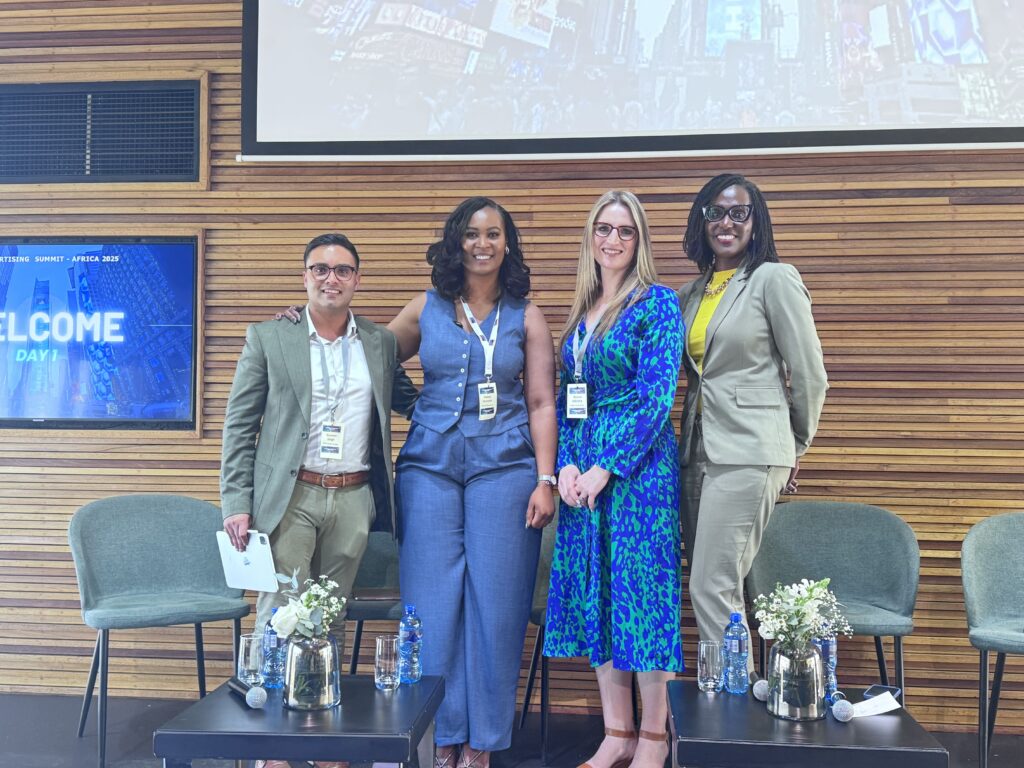
At the recently concluded Advertising & Audiences Summit – Africa held on the 16th – 17th September 2025 | Johannesburg, South Africa, at a recent industry panel discussion, I had the privilege of moderating a conversation with Bianca Sildesky (Group Innovation Director at PHD), Palesa Racheku from Plus 94 Research (Project Manager for MAPS), and Singh (Media Director at KMP Media). What emerged was a compelling argument for why the industry must evolve beyond simple reach metrics toward measuring genuine engagement and attention.
The Quality Question
“Numbers only tell us two things: is it big or is it small,” Bianca pointed out. “But what really matters is: so what?”
In a country with the world’s most unequal society and highest Gini coefficient, sheer audience size doesn’t tell the full story. The quality of attention matters profoundly, and it hinges on three critical elements:
Emotion: Neural pathways change through emotional engagement. Whether that emotion is joy, shock, or something else entirely, it’s the trigger that makes advertising memorable and drives human behavior.
Meaningful Difference: Brands must identify their unique value proposition. Trying to be everything to everyone dilutes impact and wastes precious attention.
Continuity: Building brand equity requires sustained messaging over time. While variety keeps things interesting, schizophrenic creative approaches that change constantly fail to build the mental availability necessary for growth.

The Measurement Challenge
The panel revealed a stark reality: while 18% of South Africans watch more than 20 hours of television weekly and 35% spend over 20 hours on social media, traditional measurement methods struggle to capture the full picture.
William highlighted how recall studies suffer from hindsight bias in our ad-saturated environment. “You can’t honestly remember what you watched on which station,” he noted. His work with Sync Pulse _ using mobile-based panels and fingerprinting technology – represents a shift toward passive, accurate measurement that tracks cross-platform consumption in real time.
Meanwhile, Palesa emphasized the critical importance of on-the-ground research. MAPS collects 30,000 surveys annually – 22,000 face-to-face interviews and 10,000 diaries—reaching audiences that digital tracking misses entirely. “How are we going to reach my mother?” she asked pointedly, highlighting rural and offline communities that represent substantial market segments.
The Currency Problem
Perhaps the most revealing moment came when a media day brought all major TV broadcasters to pitch a single client. Each used different data sources. Each proved they were the best investment. The marketing director’s response? “I’m so confused now, because after each one, I thought that was where we should spend all our money.”
This fragmentation creates chaos. With hundreds of media suppliers arguing their merits using incompatible metrics, advertisers face an impossible task. The industry desperately needs a unified currency – a trusted baseline that allows genuine comparison.
MAPS offers one answer: an independently audited, scientifically stratified study covering 43 million South Africans across urban and rural areas, with rigorous verification including GPS tracking, recorded interviews, and external scrutiny. It provides the cross-platform foundation that siloed digital metrics cannot.
The Attribution Reality
Modern campaigns rarely exist in isolation. A television ad drives search. Social media amplifies outdoor. Radio reinforces brand messaging seen elsewhere. Yet attribution remains frustratingly complex.
William described using real-time optimization to capture search traffic immediately following TV spots – bidding higher on keywords for three to five minutes after an ad airs to ensure proper attribution. This level of sophistication helps, but the fundamental challenge persists: who gets credit when multiple touchpoints influence a single action?
The honest answer requires excluding certain elements from measurement. When a chairman insists on buying a billboard outside his house (yes, this actually happened), it becomes a “directive” that sits outside normal attribution frameworks. Agencies must be brave enough to acknowledge these exclusions transparently.
Looking Forward: AI and Human Insight
As we closed the discussion, attention naturally turned to artificial intelligence. The consensus? AI excels at analyzing massive datasets – its expanding context windows allow it to process information at scales humans cannot match. But human judgment remains essential.
“Let AI do the analysis, but make decisions that are human-based decisions on that analysis,” William summarized. “It’s knowing how to control it, not basically letting it work for you.”
Palesa’s reminder proved particularly poignant: “AI is going to definitely take away the human element. How are we going to reach my mother?” Technology cannot replace the foundational work of understanding offline, rural, and digitally disconnected consumers who remain vital market segments.
The Bottom Line
Time spent is indeed advertising’s new currency, but only when measured with integrity, verified through independent audit, and linked directly to advertiser outcomes. Reach shows presence; time shows impact. Platforms that can demonstrate not just reach but genuine resonance—backed by transparent, trusted measurement – will secure sustained investment.
The industry stands at a crossroads. We can continue with fragmented, incompatible metrics that serve individual interests, or we can work collectively toward unified standards that benefit everyone: advertisers, agencies, media owners, and ultimately consumers who deserve relevant, engaging content.
The choice seems clear. The only question is whether we have the collective will to make it happen.
Interested in discussing measurement strategy for your brand? Get in touch with our team to explore how we can help you move beyond vanity metrics toward genuine business impact.
